
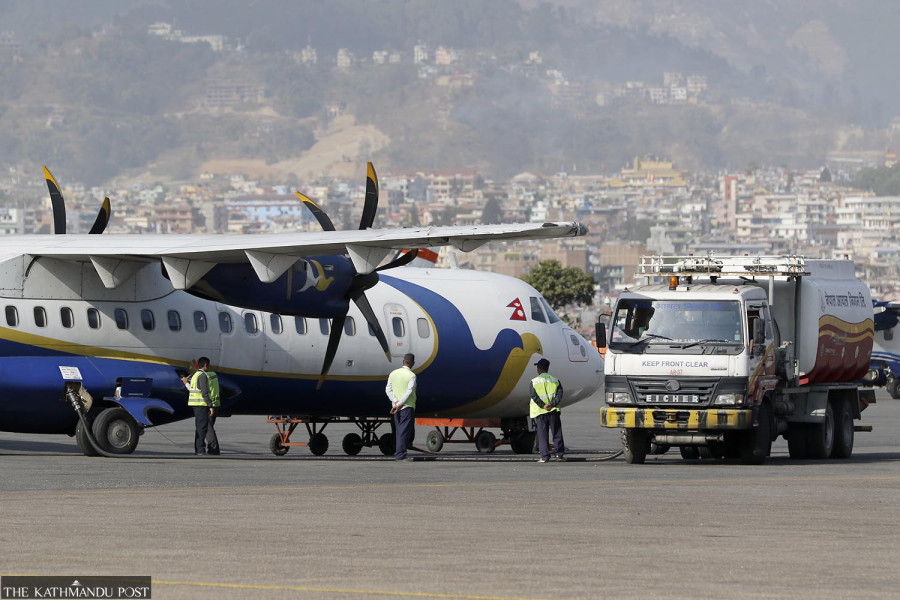
Nepali airlines in a scramble as fuel costs spike, passengers vanish
Buddha Air says daily passenger numbers have plunged by 1,500, and flights cut by 25 percent.
Domestic airlines have started losing passengers in droves after ticket prices spiked following the hike in aviation fuel.
Nepal’s largest private operator, Buddha Air, said its daily passenger numbers have dropped by 1,500 following the fare hikes. The airline previously carried around 8,000 passengers a day.
“We have cut at least 25 percent of flights per day due to low occupancy,” said Birendra Bahadur Basnet, managing director of Buddha Air.
“Fuel alone used to account for 25-30 percent of the airline’s total costs. Now, it’s 50 percent,” he said, adding that declining passenger traffic triggered by high fuel costs has eroded profits across the industry.
According to Basnet, airlines are facing a double whammy. The appreciation of the US dollar has made spare parts more expensive, further pushing up operating costs.
Nepal’s state-owned oil monopoly, Nepal Oil Corporation, sharply increased aviation fuel prices to a historic high last week, citing soaring global energy costs driven by the ongoing conflict in West Asia.
On April 1, the corporation raised the price of aviation turbine fuel (ATF) for international airlines by 77.63 percent to $1,716 per kilolitre in Kathmandu, with similar increases in Pokhara and Bhairahawa. The previous high was recorded on June 19, 2022, when ATF price reached $1,645 per kilolitre.
For domestic carriers, ATF prices have nearly doubled, jumping 97.63 percent to Rs251 per litre—an unprecedented spike. The previous high was Rs190 per litre on September 1, 2022…
Again on April 9, the corporation increased the price by Rs6 per litre to Rs257 per litre.
“This is the biggest hike in aviation fuel prices in history,” Manoj Kumar Thakur, spokesperson for the corporation, told the Post in a recent interview attributing the surge to reduced global production and heightened demand.
According to Shree Airlines, passenger movement has dropped by 30-40 percent daily. “It’s a big decline during the peak travel season,” said Anil Manandhar, corporate director at Shree Airlines. “The hike in fuel prices has not only dented domestic passenger movement, it has affected the entire tourism industry.”
Shree Airlines previously carried around 3,000 passengers daily, but the number has now fallen to about 2,000.
“We are all in survival mode. If this continues for another month, everyone will suffer, including Nepal’s economy,” Manandhar said.
Aviation turbine fuel constitutes a significant portion of airlines’ operating expenses, and sustained price increases are likely to translate into higher airfares, affecting both domestic and international passengers.
Domestic carriers are required to revise fuel surcharges when prices change by Rs4 per litre, under a formula set by the Civil Aviation Authority of Nepal.
Accordingly, the fuel surcharge on the Kathmandu–Dhangadhi sector, the longest domestic route, has increased by Rs5,480. The upper fare on this route has risen to Rs22,270 one way, including Rs2,504 in VAT and a Rs500 passenger service charge.
Following the latest revision, the lower fare on the Kathmandu–Dhangadhi sector stands at Rs16,085, while the promotional fare is Rs11,600 one way.
On the Kathmandu–Simara route, the country’s shortest, the fuel surcharge has increased by Rs1,140, pushing the total fare to Rs5,099, including Rs529 VAT and a Rs500 passenger service charge. Simara and Bharatpur routes have only a single fare category.
Domestic air traffic recorded modest growth in 2025, constrained by infrastructure bottlenecks at Kathmandu airport, sluggish tourist arrivals, and worsening pollution in the Tarai plains.
Nepal’s domestic airlines—seven fixed-wing operators and 12 helicopter companies—carried 4.56 million passengers last year, up 2.2 percent year-on-year. Despite the slowdown, this marked the highest passenger traffic ever recorded.
The number of domestic air travellers has surged more than fourfold since 2000, when only 853,000 passengers flew domestically, at a time when air travel was widely considered a luxury.
According to Tribhuvan International Airport statistics, domestic airlines carried just 98,613 additional passengers in 2025 compared to the previous year.
Saurya Airlines Pvt. Ltd
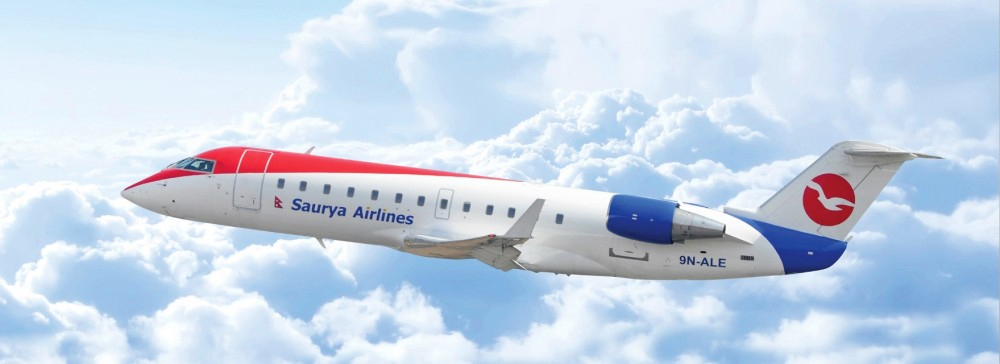
Saurya Airlines Pvt. Ltd (is an airline based in Kathmandu, Nepal. As of August 2017, the airline served five destinations across three provinces of Nepal from its hub at Tribhuvan International Airport, operating a small fleet of Bombardier CRJ-200 aircraft. Saurya Airlines was the first airline to operate the Canadair Regional Jet in Nepal, also becoming the second airline in Nepal after Cosmic Air to operate a jet engine aircraft on the domestic routes.
History
Saurya Airlines bought its first aircraft, a Bombardier CRJ-200, on 18 August 2014 and commenced its first operation on 17 November 2014 by conducting a mountain flight and a round trip to Biratnagar Airport from Kathmandu Airport after it was forced to keep its new plane grounded for nearly three months due to lengthy paperwork.The company later added a daily service to Bhadrapur making it its second southeastern destination. On 22 June 2015, Saurya Airlines launched flights to Nepalgunj which is now discontinued.
At the beginning of 2016, Saurya Airlines was constrained to operate charter flights as per the regulations of Civil Aviation Authority of Nepal after the company failed to meet the minimum required number of aircraft needed to operate as a scheduled passenger carrier. However, the company managed to provide the service to the passengers by operating scheduled charter flights. In 2016, Saurya Airlines served 90,205 passengers with the growth rate of 3.76 percent from the previous year.
In March 2017, Saurya Airlines added a second CRJ-200 to its fleet, and regained the certificate to operate scheduled flights again. This aircraft (registered 9N-AME) was painted with a “Tata Tiago livery” as per the agreement with Sipradi Trading, making the airline the first Nepalese fixed-wing aircraft company to wear the international trademark on aircraft livery.
In 2018, the airline was grounded by Tribhuvan International Airport, as it owed 30 million Nepali rupees in service charges to the airport. In March 2019, the airline cleared its dues and restarted its flight operations.
Also in 2018, the airline was sold to a group of Non Resident Nepalis for 320 million Nepali rupees. However, in 2019, the ownership changed again, when the Indian Kuber Group acquired the airline for 630 million Nepali rupees.In July 2021, some reports indicated that the airline would rebrand itself as Kuber Airlines.
On 24 July 2024, 18 of the company’s employees – including much of its senior management – were killed in a crash at Kathmandu. The following day, the airline suspended all flights due to the lack of aircraft and skilled personnel, and its certification to operate was subsequently suspended.
On 12 February 2026, it was reported that the airline had been approved to restart flight operations.
The ‘Dollar Fare’ (higher airfare) Removed
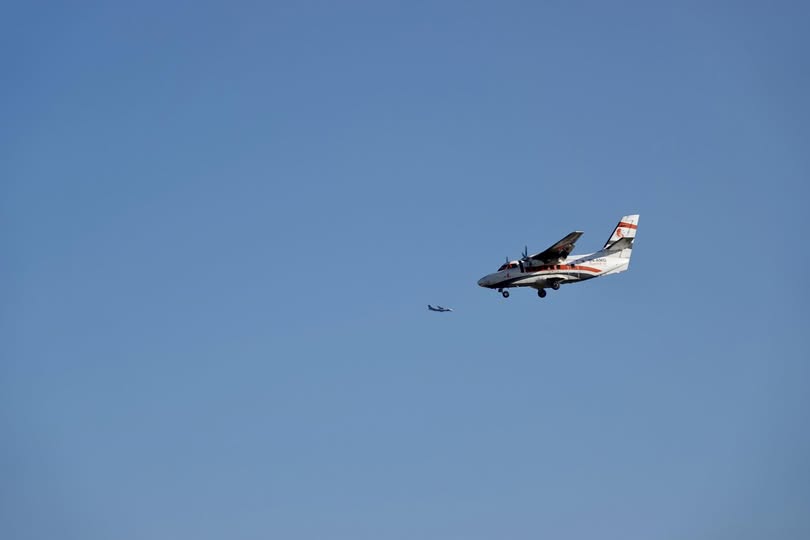
The ‘Dollar Fare’ (higher airfare) currently charged to foreign nationals and Non-Resident Nepalis (NRNs) on domestic flights in Nepal is set to be removed in the first phase, starting from the Karnali and Sudurpashchim regions.
This move is expected to promote tourism, improve accessibility, and ensure more fair and inclusive air travel across remote parts of the country.