
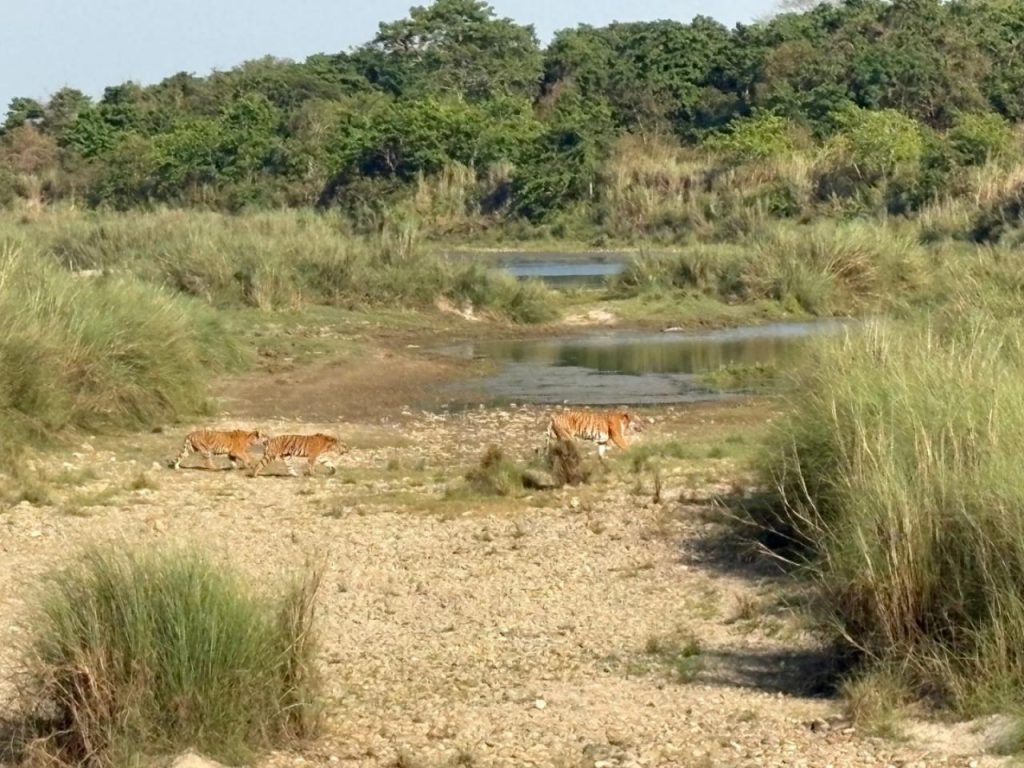
- Picture taken by Ms. Rajeena Shrestha – Sr. Manager – Tour
What an incredible sight—three tigers together in the wild at Chitwan National Park!
A rare and remarkable wildlife sighting was observed during a safari in Chitwan National Park, where three tigers were seen moving together along a riverbank. Such encounters are exceptionally uncommon, highlighting the ecological richness and successful conservation efforts within the park.
The tigers appeared calm and composed, navigating through their natural habitat of grasslands and forested areas. Their presence near a water source suggests typical behavioral patterns associated with movement, territorial activity, or possible familial grouping.
This extraordinary observation underscores the importance of Department of National Parks and Wildlife Conservation initiatives in preserving endangered species and maintaining biodiversity. Experiences like this not only enhance the value of wildlife tourism in Nepal but also reinforce the global significance of conservation efforts in protecting habitats for future generations.
Vehicle Free Ason
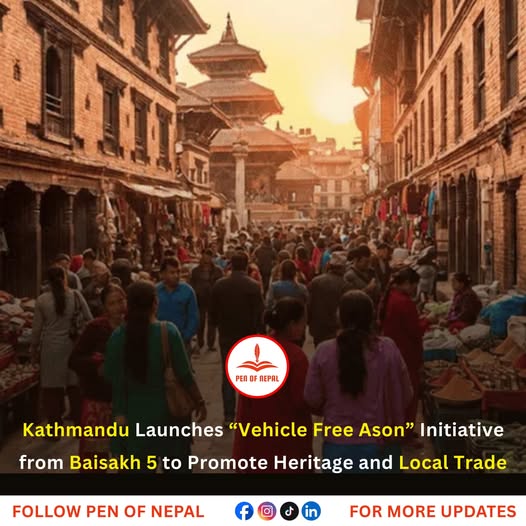
Kathmandu Metropolitan City has announced “Vehicle Free Ason” starting from Baisakh 5, 2083, aiming to promote a vibrant and cultural Ason area. The initiative will restrict vehicle entry every Saturday in key routes from Kamalakshee, Bhotahiti, and Mahabouddha to Ason. The area will develop as a heritage zone supporting local trade, culture, and social activities under city police management.
Asan is a heritage site in kathmandu, it is a ceremonial, market and residential square in central Kathmandu, the capital of Nepal. It is one of the most well-known historical locations in the city and is famed for its bazaar, festival calendar and strategic location.
Manang lodge named among TIME’s ‘World’s Greatest Places to Stay’
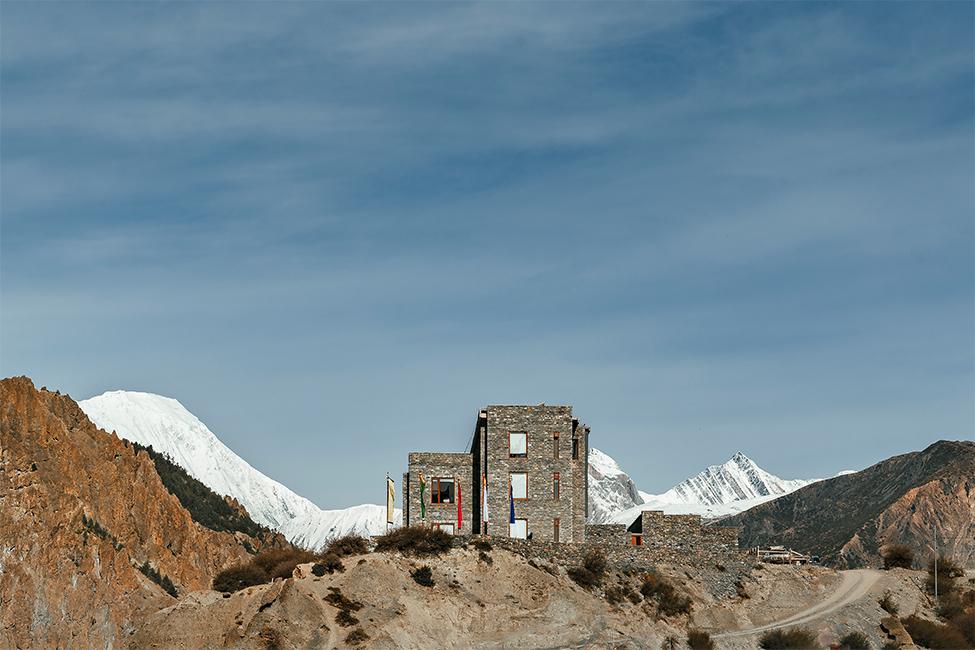
Mountain Lodges of Nepal (MLN) – Manang has been recognised as one of the “World’s Greatest Places to Stay” by TIME.
The magazine described the property as a rare upscale retreat in one of Nepal’s most iconic trekking regions.
“Perched above the yak-dotted Marsyangdi River valley, Mountain Lodges of Nepal’s 14-room, stone-built Manang Lodge is the first upscale accommodation in the region,” TIME wrote in its listing.
The magazine also noted that the once legendary Annapurna Circuit has changed dramatically over the years due to expanding road networks.
“Once trekking’s crown jewel, the Annapurna Circuit has been reshaped by road construction, compressing what was once a month-long, 150-mile journey into as little as eight days,” it said.
At the same time, the improved infrastructure has made Manang easier to reach for travellers.
“That same infrastructure has also made Manang more accessible, now reachable via a roughly 10-hour drive from Kathmandu—or quick heli from Pokhara,” the magazine wrote.
From the lodge, guests can explore the nearby Manang village, the centuries-old Braga Monastery, glacial lakes and sacred meditation caves. The lodge also organises excursions to quieter trekking routes such as the lower base camp of Annapurna IV, where visitors are served picnic lunches.
According to TIME, Manang also attracts wildlife enthusiasts during the winter months, when the region is considered one of Nepal’s best places to spot the elusive Snow Leopard.
The property is managed by Sherpa Hospitality Group, which says the lodge aims to provide a comfortable base for travellers exploring the high Himalayas.
Rather than moving between different lodges during a trek, guests stay at MLN Manang at an altitude of around 3,500 metres and set out on guided day trips before returning to heated rooms, ensuite bathrooms, hot showers and locally inspired cuisine.
“This base camp model makes the legendary Annapurna region accessible to a broader spectrum of travellers, from seasoned trekkers to those who want high-altitude adventure without sacrificing comfort and style,” the group said.
The Manang valley lies high above the Marsyangdi River and is surrounded by dramatic peaks, glacial lakes and traditional Himalayan settlements.
Its combination of alpine landscapes, deep-rooted Buddhist traditions and living mountain cultures makes it well suited for a base-camp style of travel, where visitors explore different parts of the valley through daily excursions.
Within a short distance, travellers encounter diverse communities, monasteries, chortens and prayer-flag-lined trails that reveal a concentration of cultural and spiritual heritage rarely found in a single Himalayan valley.
Despite its remoteness, improved road access and helicopter connectivity from Kathmandu allow travellers to reach the region with relative ease while still experiencing a destination that remains largely off the beaten path.